Exclusive Residences Observatory - First Half of 2026

WE HAD LOVED EACH OTHER SO MUCH: SEPARATE SUPPLY AND DEMAND AT HOME
Purchases and sales
The market for luxury residences in Milan saw no major upheavals during the first half of 2026, essentially confirming the trends that had already emerged in the second half of 2025.
On the demand side, foreign demand continues to drive the Top (over 3 million euros) and Luxury (over 6 million) segments, although it has declined somewhat from the highs reached in the previous three-year period.
“While the influx of new residents is stabilizing, it is accompanied by a significant rise in the quality expected from a new home, with demand increasingly concentrated in the luxury niche,”comments Gabriele Torchiani.“Buyers are looking for one-of-a-kind properties and very distinctive or unique features. In this context, thesupply remains extremely limited and often consists of homes of insufficient quality to appeal to a highly selective clientele, or of high-quality residences with highly speculative asking prices.”
The situation is different in the mid-range segment (1–3 million), where buyers are almost entirely Italian and maintain a cautious and selective approach.
This cautious attitude stems from two main factors: on the one hand, the difficulty of finding properties that offer a genuine step up in quality—which is the primary motivation for those who already own a home in Milan; on the other hand, the wide variation in asking prices for properties perceived to be of similar quality, which fuels uncertainty among potential buyers, significantly raising their level of caution and slowing down their purchasing decisions.
On the supply side, the situation remains unchanged: the structural shortage of high-quality properties has persisted for five years now, exacerbated by a general slowdown in the availability of new construction.
Sales volumes are stagnating across all price ranges, albeit for different reasons, and despite an apparent increase in supply driven by owners entering the market—motivated more by speculation linked to the record prices they read about in the media than by a genuine intention to sell.
As a result,the average absorption rate —the proportion of properties sold out of the total available inventory—has weakened, falling by nearly 4 percentage points over the first half of the year to 17.6 percent: a figure well below the peak reached in 2022, when the rate exceeded 27 percent.
The average time to sell has lengthened slightly, rising to 7.5 months (from 7 months in the second half of 2025), and at the same time, the gap between the asking price and the actual closing price has also widened, reaching 9.2% (the 2025 average was 8.4%). While the increase over the half-year is modest, the rise from 2022 to the present—when the average discount was around 5%—is far from negligible: it signals a growing willingness among owners to accept offers below their asking prices, especially for properties that have been on the market for a long time or have an unrealistic asking price.
The average time on the market for unsold properties is also rising, now well over 26 months: more than two years is not enough for the market to absorb homes that lack quality or offer poor value for money.
In terms of asking prices, there has been an acceleration that breaks the trend maintained since 2021, which consisted of modest increases of around 1% per year. In fact, the first half of 2026 marks a significant jump: in just six months, the maximum average price (referring to the top quartile of the distribution, i.e., the most prestigious homes) rose by 2.3%; the minimum average price (referring to the bottom quartile, i.e., relatively less expensive homes) rose by 1.7%, while the overall average price increased by 2%.
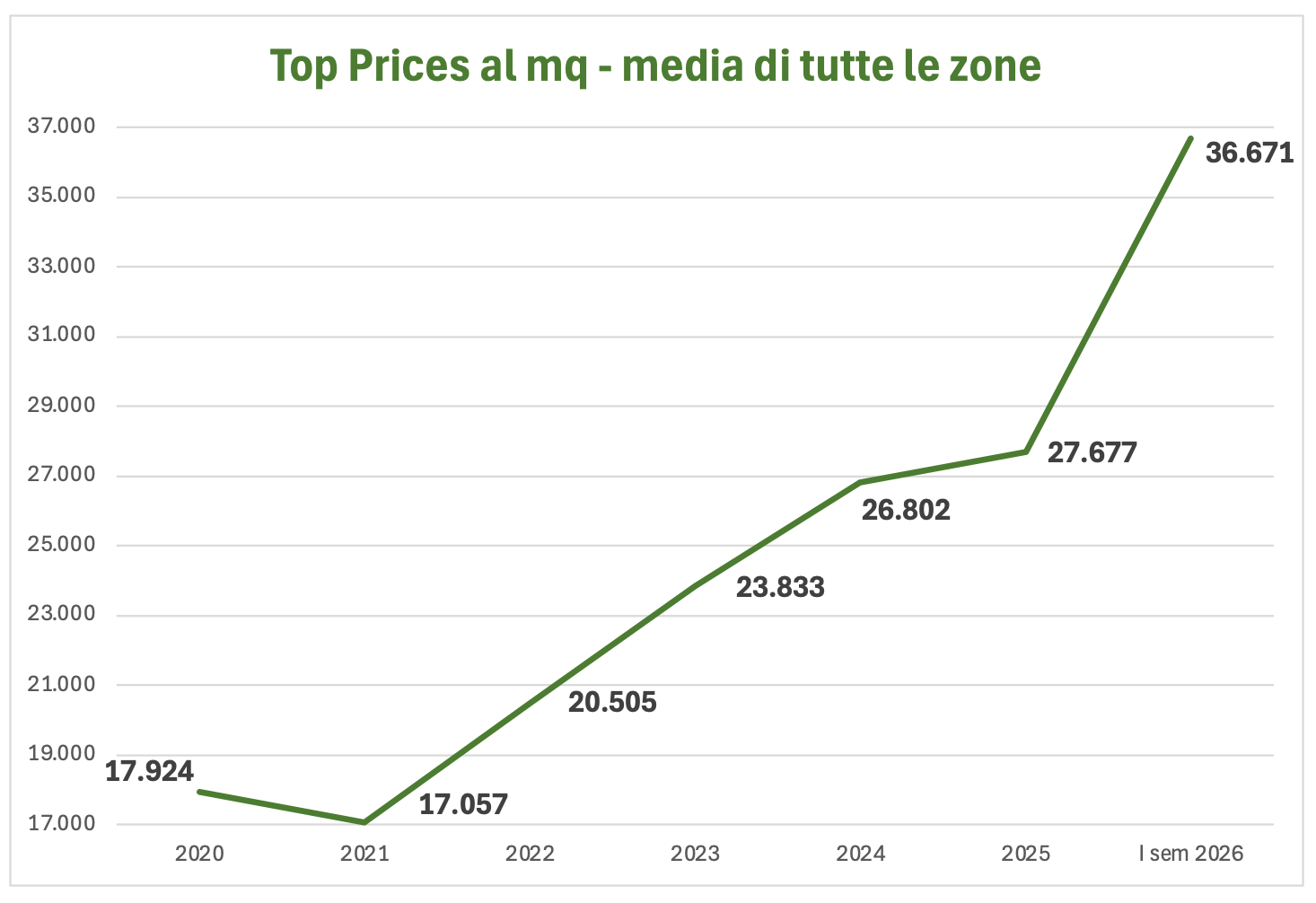
In every area analyzed, there is at least one home with an asking price well above €30,000, except for the Historic Center, where the highest asking price exceeds “only” €28,000. In the Quadrilatero, the highest recorded price is €47,000. The increase in the highest price is fairly uniform across the city, with the sole exception of the Historic Center, where the growth is less pronounced.
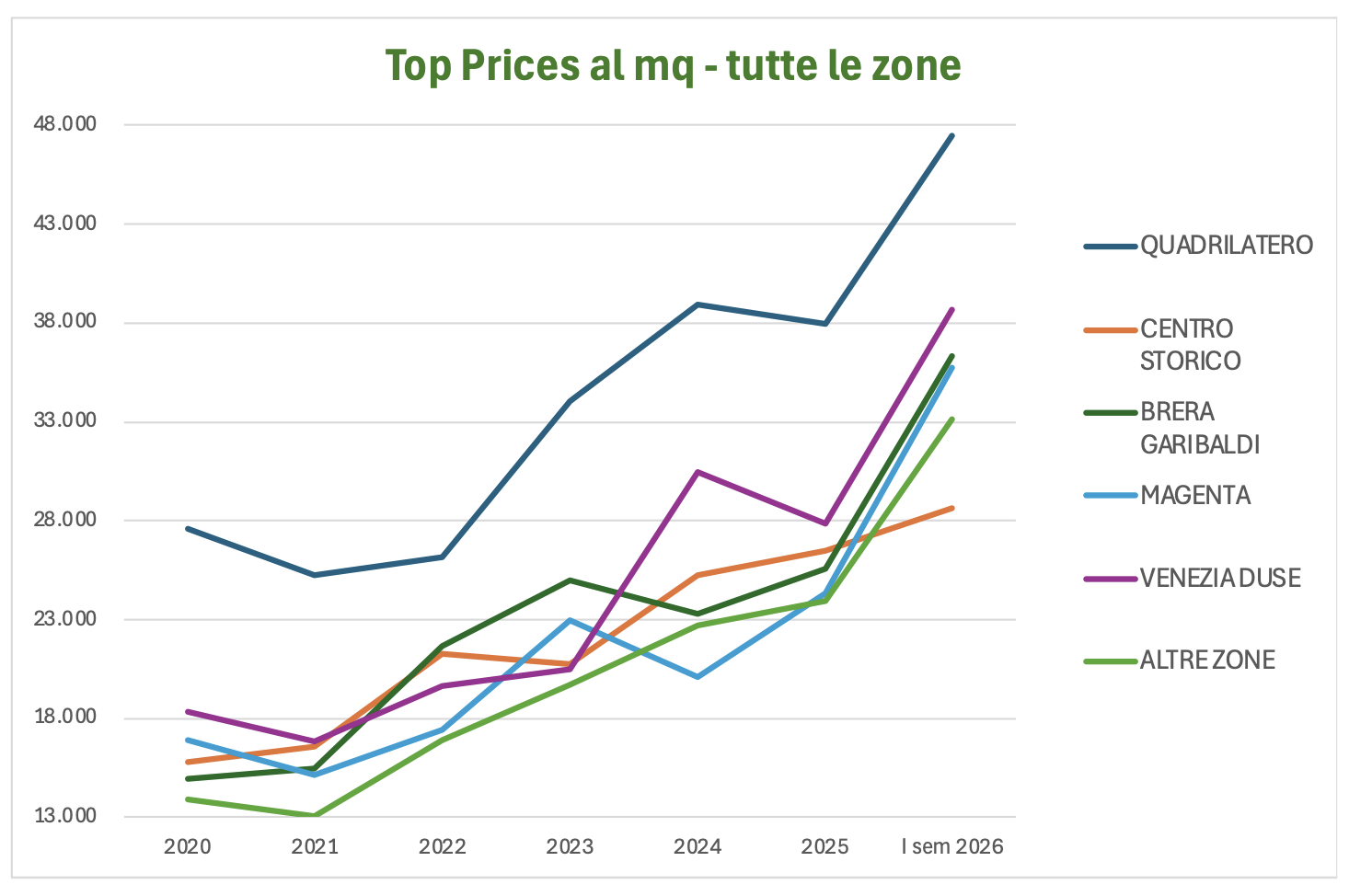
This highly visible phenomenon soon spread to the high-end and mid-range segments as well, where many sellers raised their asking prices to capitalize on nonexistent speculative opportunities, overlooking the very limited correlation between the few transactions in the luxury segment and the market as a whole.
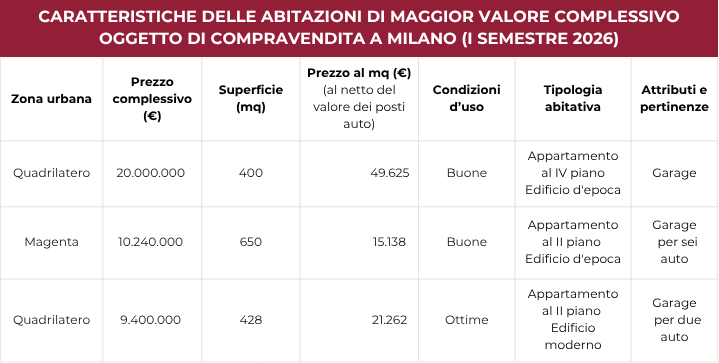
The three most significant transactions of the half-year totaled nearly 40 million euros, with prices per square meter ranging from 15,000 euros to nearly 50,000 euros in the Quadrilatero district.
In terms of reasons for purchasing, the picture remains similar to that of the previous half-year: 61% are buying to meet their primary housing needs, 33% to replace their current home, while pure investment has fallen further to 6%, impacted by the more attractive returns offered by alternative assets characterized by greater liquidity.
Foreign investors: The slowdown in new applications to transfer tax residency to Italy appears to be primarily attributable to the gradual conclusion of the special phase that characterized the 2024–2025 period.“In particular,” says Marco E. Tirelli, “the abolition of the UK’s ‘non-dom’ regime had spurred an acceleration in decisions by tax-mobile individuals to relocate to Italy, with Milan among the top European destinations. Now that this ‘one-time’ component of demand has run its course, it is only natural to expect a return to more ordinary levels of inflow. Compounding this effect is the increase in the flat tax, which was first raised from 100,000 to 200,000 euros and, for new participants starting in 2026, to 300,000 euros annually. The regime remains highly attractive to individuals with very high foreign assets and income, but the tax increase raises the economic threshold beyond which relocation becomes advantageous and makes other jurisdictions that offer favorable tax regimes for high-net-worth individuals relatively more competitive.”
It is therefore plausible that the observed decline in the number of new applicants does not so much reflect a waning of interest in Milan as it does a combination of the fading of the one-time effect linked to the British tax reform, the rising cost of the Italian tax regime, and increased international competition in attracting high-net-worth individuals.
The leases
In line with the trend that began in the second half of last year, rental demand is returning to normal across all segments—Mid-range (40,000–90,000 euros per year, excluding expenses), High-end (90,000–170,000 euros), and Luxury (over 170,000 euros)—with requests in the first half of the year lower than those recorded in the 2023–2025 period.
“This is a natural readjustment following a growth phase that lasted at least five years, driven in the Top and Luxury segments primarily by the appeal of the flat tax,”notes Torchiani.“In these segments, demand originates mainly from two channels: on the one hand, direct demand, consisting primarily of foreigners, corporate expats, and international professionals seeking high-end solutions; on the other hand, so-called ‘bridge demand,’ that is, families who, unable to become homeowners in a market with a chronically insufficient supply, choose to rent as a temporary solution while continuing their search for a property to purchase.”
Across all price brackets—and especially in the top two—the real weak point remainssupply: although demand is less robust than in the past, it continues to outstrip actual availability. Truly exclusive properties, with striking views and high-end finishes, remain rare on the market; the best listings have already been snapped up by the wave of new arrivals recorded during the 2023–2025 period.
The rental absorption rate closed the half-year at 33.7%, down 1.9 percentage points from the previous period. This result reflects three competing trends: a decrease in the number of contracts actually signed, a slight increase in supply due to the shift of some properties from the short- and mid-term rental market, and an average quality of the housing stock that sometimes falls short of the international standards that increasingly shape the expectations of potential tenants.
The average time it takes to finalize a lease agreement remains virtually unchanged, at 3.9 months.
The average discount, on the other hand, has risen, reaching 6% (+0.8 percentage points over the half-year).
The market’s temporal polarization is becoming increasingly pronounced: the quality of the property ultimately determines very different outcomes. Truly high-end residences quickly find a tenant, allowing owners to maintain their asking rent. When a lease isn’t finalized within 3–4 months, it’s a sign that the property has some issues—whether related to location, condition, or a rent that’s out of line with the market. In such cases, the first failed attempt is often followed by a rent reduction (about 15%), though this is sufficient to make the property more attractive only in a minority of cases. This is confirmed by the fact that the average time vacant for apartments remains stable at over 10 months: a backlog that reflects a weak supply, which has remained on the fringes of the market, unable to attract tenants even as economic conditions gradually improve.
Rents are affected by this market trend: the minimum average—a proxy for less desirable properties—fell by 0.8%; the overall average declined by only 0.3%, partially offset by further growth in the maximum average (+0.7%). At the top of the pyramid, however, performance remains extraordinary: Top Rents set a new record, exceeding €800/sq m/year citywide, with peaks of up to €1,200 in the Quadrilatero.
At least two factors contribute to these values: the chronic shortage of premium supply and the presence of international tenants, for whom this level of rent is already an established standard in their respective home markets.
It should be noted that the survey does not include short- and mid-term leases, which are managed by specialized operators using different pricing models: since these arrangements include ancillary services and integrated management, their rental rates are not directly comparable to those of traditional 4+4 residential leases and, in fact, constitute a parallel market with its own dynamics.
Milan is strengthening its profile as a global city, as confirmed by the composition of rental demand: in the two highest price brackets, international tenants now account for well over one-third of the total, a share that has been steadily increasing in recent years.
If we look at the segmentation by home size, the divide is even more pronounced: in homes larger than 300 square meters, the presence of foreigners and returning Italian expats has become nearly universal. This segment now operates according to its own rules, detached from the domestic market, and follows the logic and standards typical of major international capitals.
Forecasts for the second half of 2026
REAL ESTATE SALES: For the mid-range segment (1–3 million), the coming months are expected to be marked by uncertainty, given the risk that international geopolitical and economic tensions could trigger a recession. Once again, much will depend on the quality of the properties coming onto the market.
In the top price bracket (3–6 million), where the presence of Italian and foreign buyers is more evenly balanced, the two groups continue to operate according to different logic: Italians may slow down due to the same macroeconomic uncertainties already mentioned, while foreigners—driven primarily by tax advantages that accelerate their decisions—appear more immune to these dynamics.
“The luxury segment (over 6 million) remains a market of its own,”concludes Tirelli,“driven almost exclusively by foreign demand. In numerical terms, its share of total transactions remains marginal, and each individual transaction tends to be a case unto itself, driven more by personal choices than by general market trends. Beyond the differences between the various segments, one common thread remains: market trends in the coming months—especially in terms of the number of transactions—will depend to a decisive extent on the ability of the supply side to meet the standards demanded by an increasingly discerning and selective clientele, and on greater alignment between asking prices and the actual quality of the properties on the market.”
RENTALS: The overall picture is that of a mature rental market, which is stabilizing after the peaks of the previous three-year period, though it remains constrained by structural supply limitations.
It is reasonable to expect this balance to hold, albeit with some differences across segments: in the High-End and Luxury segments, foreign demand—though declining—should continue to keep rents at current levels, provided that new high-quality properties emerge, including from a possible further return of properties currently used for short-term rentals. In the Mid-Range segment, rents could see a downward adjustment, especially at the lower end of the segment.